
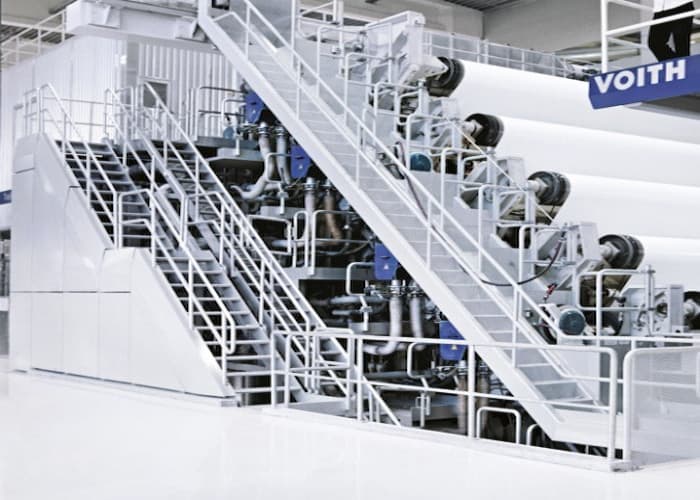
Papermaking Machinery
Papermaking machinery pushes bearings to extremes. A single paper machine combines water, heat, steam, dust, and continuous high-speed rotation, and each section creates its own failure risks. Industry lubrication guidance notes that the forming (wet) section, press section, drying section, and reeler all expose bearings to different threats—from water and steam to dust—making bearing selection and lubrication strategy critical for reliability.
That’s why many maintenance and engineering teams search for DKFL bearings for papermaking machinery: they want stable operation, fewer unplanned stops, and predictable maintenance intervals. DKFL positions itself as a supplier delivering bearing solutions across many industries, backed by manufacturing and engineering development.
Where bearings matter most on a paper machine
Papermaking equipment includes dozens of rolls and rotating assemblies, but the most demanding bearing zones are typically:
-
Wire / forming (wet) section: water exposure, contamination, corrosion risk
-
Press section: high nip loads, shock, moisture and heat
-
Dryer section: elevated temperatures, continuous rotation, dimensional stability requirements
-
Calendar / reeler / winder areas: speed, vibration control, consistent torque
-
Auxiliaries: pumps, fans, gear drives, agitators (often easier to standardize)
A proven reliability lesson from real mills is that sealing matters as much as the bearing itself. In one SKF wet-section case study, switching to sealed bearings helped reduce water-related corrosion, extend service intervals, and cut grease consumption—exactly the kind of outcome paper mills chase to reduce housekeeping and downtime.
DKFL bearing types that fit typical papermaking load cases
Papermaking machinery often combines heavy radial loads, intermittent axial loads, and misalignment from roll deflection or housing distortion. These are classic conditions for roller bearing solutions.
1) Spherical roller bearings for heavy loads + misalignment
Spherical roller bearings are widely used in pulp and paper because they can carry very heavy radial loads plus axial loads and tolerate misalignment—useful for rolls and cylinders across multiple sections.
DKFL’s roller-bearing portfolio includes spherical roller bearing families suitable for these heavy-duty positions, where long life and robustness are priorities.
2) Cylindrical roller bearings for high radial load + speed
When radial load dominates and speed is higher (common in certain roll supports and driveline positions), cylindrical roller bearings are often selected for stiffness and efficient rotation. Guidance on cylindrical roller bearings highlights their ability to handle heavy radial loads at high speeds, and many designs can accommodate axial displacement—helpful for thermal growth management in long machines.
DKFL offers cylindrical roller bearing ranges that can be matched to these applications by size series and internal design.
3) Deep groove ball bearings for auxiliaries and lighter-duty stations
For motors, fans, smaller shafts, and general rotating components, deep groove bearings are commonly used—often in sealed variants to retain lubricant and reduce ingress. DKFL lists many deep groove bearing variants (including sealed types) that can support standardization across mill auxiliaries.
A practical selection checklist for DKFL bearings in papermaking machinery
To get maximum value from DKFL bearings in paper machines, use a system approach:
-
Map the section environment (wet, hot, dusty, chemical exposure).
-
Choose bearing type by load + misalignment: spherical rollers for heavy/misaligned rolls, cylindrical rollers for heavy radial load and speed, deep groove for auxiliaries.
-
Prioritize sealing in wet zones to reduce water ingress, corrosion, and grease washout.
-
Validate ratings using DKFL catalog data (dynamic/static load ratings and speed limits) before trials and commissioning.
-
Set lubrication to match heat and contamination, then monitor temperature/vibration to catch problems early.
Conclusion
Papermaking machinery rewards bearings that can survive wet contamination, high temperatures, and continuous duty. DKFL’s mix of roller bearings (for heavy loads and misalignment) and deep groove bearings (for auxiliaries and standardized parts) can fit many paper machine positions when specified with the right sealing and lubrication strategy. Use DKFL catalog ratings to confirm load and speed margin, and treat sealing as a reliability “multiplier”—especially in the wet end.