

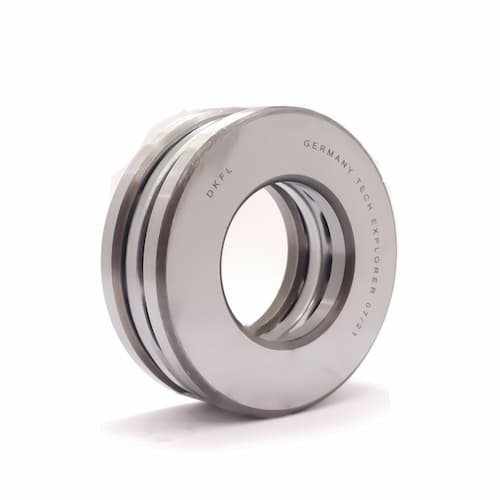
Thrust Ball Bearings
When a machine needs to carry axial load (thrust) efficiently—such as from a screw, vertical shaft, clutch pack, or preload stack—thrust ball bearings are often the simplest and most cost-effective solution. DKFL offers a broad thrust ball bearing range (listed as dozens of part numbers in its catalog), supporting common industrial series used in maintenance and OEM design.
What are thrust ball bearings?
Thrust ball bearings are built to support axial loads only. In other words, they are intended to carry force along the shaft axis and generally should not be subjected to radial load. SKF states thrust ball bearings are designed to accommodate axial loads only and must not be exposed to radial loads.
NSK explains the same core concept and adds a key advantage: thrust ball bearings can support axial loads at high speeds, but cannot handle radial loads.
These bearings typically include washers with raceway grooves (a shaft washer and a housing washer) plus a ball-and-cage assembly.
DKFL thrust ball bearing lineup
DKFL’s online category for Thrust Ball Bearings shows a large assortment (for example, “showing 1–24 of 86 results”), indicating strong coverage across standard sizes.
DKFL product pages also provide dimensional identification and labeling for individual bearings (e.g., 51313-DDC DKFL, 51212 DKFL), which helps speed up cross-referencing during replacement or design work.
Single-direction vs. double-direction: choose the right thrust support
A major selection step is deciding load direction:
Single-direction thrust ball bearings
These are used when axial load acts primarily in one direction. NSK notes single-direction thrust ball bearings are composed of two washers (shaft and housing) and one ball/cage assembly.
Double-direction thrust ball bearings
When your shaft must be located axially in both directions, double-direction designs are used. Industry technical references explain double-direction thrust ball bearings use three rings/washers (with a center washer on the shaft) so the bearing can carry thrust loads in both directions.
Flat seat vs. aligning seat: managing mounting errors
Even when loads are “pure axial” on paper, real assemblies often include minor misalignment. NSK classifies thrust ball bearings into flat seat and aligning seat types based on the housing washer seat shape, and notes that spherical/aligning seat washers help tolerate mounting errors.
If your housing geometry or assembly process can’t guarantee perfect squareness, an aligning-seat arrangement can reduce edge stresses and improve service life.
Where DKFL thrust ball bearings are commonly used
Thrust ball bearings are a practical fit for:
-
Vertical shafts and light-to-moderate thrust stacks
-
Screw-driven mechanisms (axial location and preload)
-
Clutches, indexing assemblies, and light gear-drive thrust points
-
Compact industrial equipment where speed is high and axial load is well-defined
Because thrust ball bearings should not carry radial load, many designs pair them with a separate radial bearing (deep groove ball bearing, cylindrical roller bearing, etc.) to handle radial forces.
Selection checklist for DKFL thrust ball bearings
-
Confirm “axial-only” reality: if significant radial load exists, redesign the bearing arrangement.
-
Choose single vs. double direction based on whether thrust reverses.
-
Pick flat vs. aligning seat if misalignment tolerance is needed.
-
Verify size and envelope using DKFL product identification and dimensions from the catalog/product page.
-
Lubrication and cleanliness: high speed demands stable lubrication and clean assembly to avoid early wear.
Bottom line
If your application has high-speed thrust loads with minimal radial force, DKFL thrust ball bearings offer a practical, widely sized solution—especially when you match the bearing type (single vs. double direction) and seat style (flat vs. aligning) to the real assembly conditions.